Bu matn hozircha boshqa tilda mavjud.
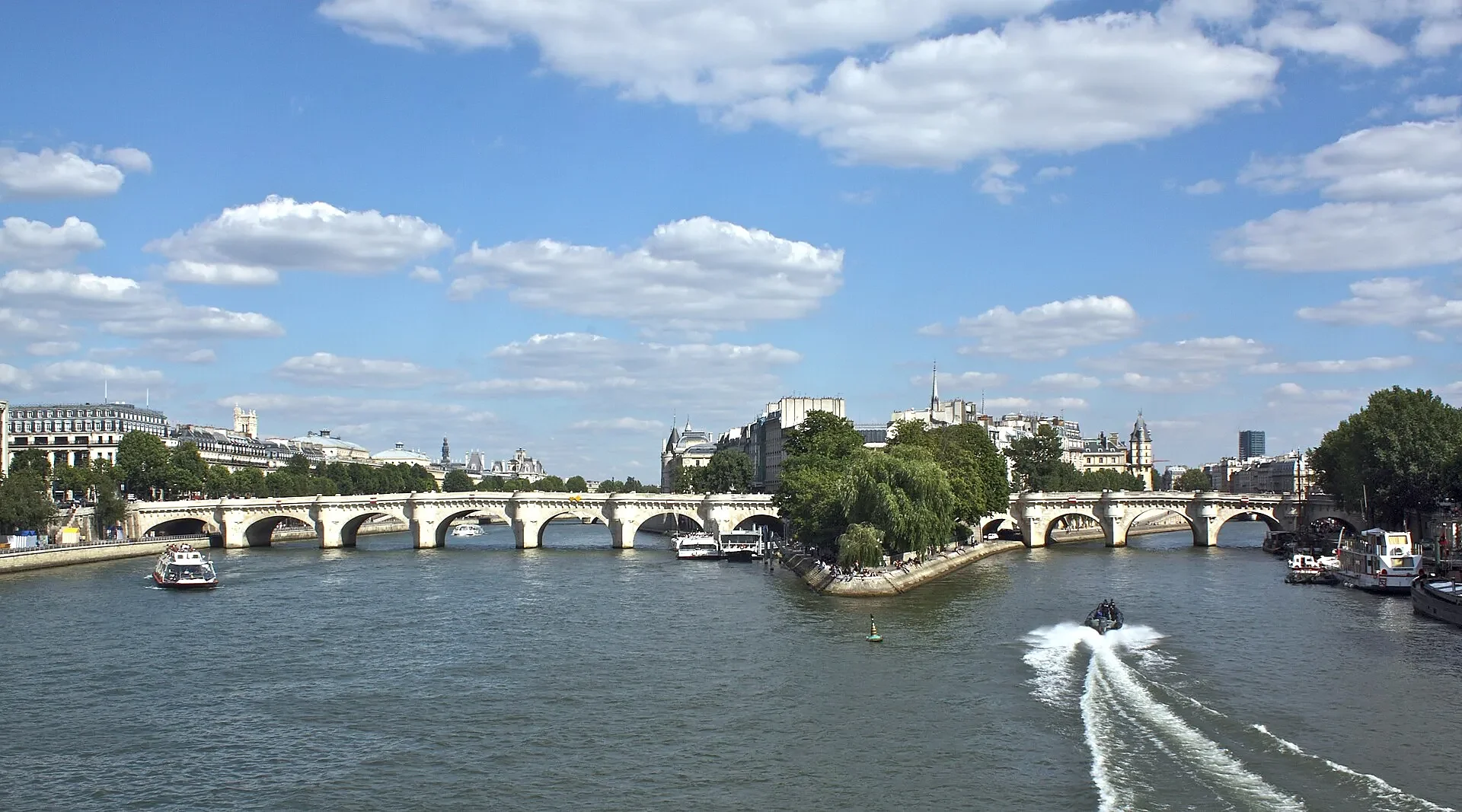
The Pont Neuf (French pronunciation: [pɔ̃ nœf], "New Bridge") is the oldest standing bridge across the river Seine in Paris, France. It stands by the western (downstream) point of the Île de la Cité, the island in the middle of the river that between 250 and 225 BC was the birthplace of Paris (then known as Lutetia). During the medieval period, the Île was the heart of the city.
The bridge is composed of two separate spans, one of five arches joining the left bank to the Île de la Cité, another of seven joining the island to the right bank. Old engraved maps of Paris show that the newly built bridge just grazed the downstream tip of the Île de la Cité; since then, the natural sandbar building of a mid-river island, aided by stone-faced embankments called quais, has extended the island. Today the tip of the island is the location of the Square du Vert-Galant, a small public park named in honour of Henry IV, nicknamed the "Green Gallant".
Пон-Нёф (в переводе — Новый мост, фр. Pont Neuf) — старейший из сохранившихся мостов Парижа через реку Сену. Построен в XVI—XVII веках. Сейчас является одним из символов Парижа.
Der Pont Neuf (deutsch Neue Brücke) ist die älteste im Originalzustand erhaltene Brücke über die Seine in Paris. Ihr Bau begann 1578 und dauerte bis 1607 an.
Le pont Neuf ou Pont-Neuf est, malgré son nom, actuellement le pont le plus ancien existant à Paris. Il traverse la Seine à la pointe ouest de l'île de la Cité.
Construit à partir de la fin du XVIe siècle et terminé au début du XVIIe, il doit son nom à la nouveauté que constituait à l'époque un pont dénué d'habitations et pourvu de trottoirs protégeant les piétons de la boue et des chevaux. Il est aussi le tout premier pont de pierre de Paris à traverser entièrement la Seine. La graphie aujourd'hui préconisée est « le pont Neuf », mais on a longtemps écrit ce nom : « le Pont-Neuf ».
Ce monument fait l’objet d’un classement au titre des monuments historiques depuis 1889. En 1991, il a été inscrit au patrimoine mondial de l'Unesco, avec l'ensemble des quais de la Seine à Paris.
Ce site est desservi par la ligne 7 à la station de métro Pont-Neuf.
El Pont Neuf (lit., 'Puente Nuevo') es, pese a su nombre, el puente más antiguo de los que cruzan el Sena a su paso por París, localizado en la punta occidental de Île de la Cité.
Construido a finales del siglo XVI y terminado al comienzo del XVII, debe su nombre a la novedad que era en ese momento un puente desprovisto de casas y que proporcionaba aceras para proteger a los peatones del barro y de los caballos. También fue el primer puente de piedra en París que cruzaba todo el Sena. Aparece escrito «le pont Neuf», pero también «le Pont-Neuf».
En 1889, el puente fue clasificado como monumento histórico. En 1999, la Unesco inscribió el sitio "Riberas del Sena en París" como Patrimonio Mundial, con referencia 600. El puente Nuevo fue incluido en dicho sitio, pero sin inscripción individual.
Este sitio es servido por la estación de Pont Neuf.
Pont Neuf adının anlamı olan "yeni köprü"nün aksine Paris 6. bölgedeki Seine nehri üzerinde bulunan en eski köprüdür.
Île de la Cité'nin batı ucunda bulunmaktadır. Rive Gauche ile Rive Droite'i birbirine bağlar.
新桥(法语:Pont Neuf),是法国巴黎塞纳河上最古老的桥,“新桥”这个名称是为了从许多连结两岸的桥梁中区别出来而取的。
新桥位于西堤岛(位于塞纳河的中心,也是巴黎历史的核心)的西边,连结巴黎的左岸(巴黎的南部)与右岸。新桥长278米(912英尺),宽28米(大约92英尺),可以分成两个部分,西堤岛与左岸之间的部分有5个拱,与右岸连接的部分则有7个拱。
Manba: Vikipediya – “Pont Neuf” · CC BY-SA 4.0
Boshqa tillarda o‘qish: · · · · · ·