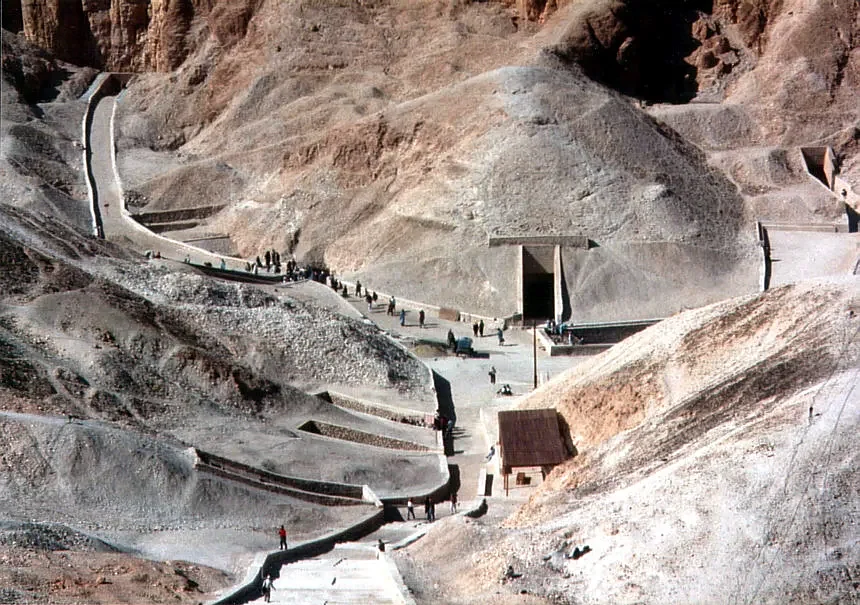
Shohlar vodiysi (arabcha: وادي الملوك Vadi-el-Mulk, kopt. ϫⲏⲙⲉ) — yangi Qirollik davrida (miloddan avvalgi XVI asrdan miloddan avvalgi XI asrgacha taxminan 500 yil) firavnlar va ularning bir qator yuqori lavozimli amaldorlari va qarindoshlari uchun qabrlar qurilgan. Misrdagi tosh darasi. Shohlar vodiysi ikki qismdan iborat: Sharqiy, qabrlarning asosiy massivi joylashgan va g'arbiy, qabrlarning kichik guruhi joylashgan, eng kattasi Amenxotep III maqbarasi.
Долина Царей (араб. وادي الملوك Вади-эль-Мулюк, копт. ϫⲏⲙⲉ) — скалистое ущелье в Египте, где за период Нового царства (примерно 500 лет с XVI века до н. э.
The Valley of the Kings, also known as the Valley of the Gates of the Kings, is an area in Egypt where, for a period of nearly 500 years from the Eighteenth Dynasty to the Twentieth Dynasty, rock-cut tombs were excavated for pharaohs and powerful nobles under the New Kingdom of ancient Egypt.
It is a wadi sitting on the west bank of the Nile, opposite Thebes (modern-day Luxor) and within the heart of the Theban Necropolis. There are two main sections: the East Valley, where the majority of the royal tombs are situated; and the West Valley, otherwise known as the Valley of the Monkeys.
With the 2005 discovery of a new chamber and the 2008 discovery of two further tomb entrances, the Valley of the Kings is known to contain 65 tombs and chambers, ranging in size from the simple pit that is KV54 to the complex tomb that is KV5, which alone has over 120 chambers for the sons of Ramesses II. It was the principal burial place for the New Kingdom's major royal figures as well as a number of privileged nobles.
Das Tal der Könige (arabisch وادي الملوك, DMG Wādī al-Mulūk; auch Wadi el-Muluk, Bibân el-Molûk, Biban el-Muluk) – gelegen in der Nähe des altägyptischen Theben, heute etwa 5 km nordwestlich des Zentrums der oberägyptischen Stadt Luxor – war eine Nekropole im Alten Ägypten, in der bis heute 64 Gräber und Gruben aufgefunden wurden. „KV65“ ist eine Radaranomalie, die als Grab gedeutet wird, aber bis heute nicht weiter untersucht wurde. Altägyptisch wurde das Tal der Könige als Sechet-aat (Sḫt ˁ3t), „großes Feld“, bezeichnet.
Im Tal der Könige sind insbesondere die Gräber der Herrscher des Neuen Reichs (ca.
La vallée des Rois est une région d'Égypte située sur la rive occidentale du Nil à hauteur de Thèbes (aujourd'hui Louxor). La vallée est formée d'une faille dans la chaîne Libyque qui débouche sur la vallée du Nil. Son nom arabe (وادي بيبان الملوك / wādī bībān al-mulūk) signifie « vallée des deux portes des rois », en référence aux portes qui fermaient jadis les tombeaux.
La vallée des Rois est connue pour abriter les hypogées de nombreux pharaons du Nouvel Empire, mais elle abrite également les tombeaux de certaines épouses et enfants de pharaons, ainsi que celles de nobles dont les pharaons ont voulu récompenser la valeur.
El Valle de los Reyes (en árabe: Uadi Abwāb Al-Muluk (وادي أبواب الملوك) lit. Valle de las Puertas de los Reyes) es una necrópolis del antiguo Egipto, en las cercanías de Luxor, donde se encuentran las tumbas de la mayoría de faraones del Imperio Nuevo (dinastías XVIII, XIX y XX) y de algunos animales. Popularmente era conocido por los egipcios como Ta-sekhet-ma'at (Gran Campo).
Forma parte del conjunto denominado Antigua Tebas con sus necrópolis, declarado Patrimonio de la Humanidad por la Unesco en 1979. Se encuentra situado en la zona desértica (Desheret, la «Tierra Roja») de la orilla occidental del Nilo, frente a Tebas (moderna Luxor), en el corazón de la necrópolis. El valle se compone de dos valles: el Valle Este, donde se encuentran las tumbas enumeradas con el código KV (King's Valley), y el Valle Oeste, con las tumbas designadas con WV (West Valley).
El valle está dominado por la colina con forma de pirámide que los egipcios llamaban Dehenet-Imenet, «la Cima de Occidente», actualmente el-Qurn; allí moraba la diosa cobra Meretseger, "La que ama el silencio", protectora de la necrópolis.
Krallar Vadisi ya da Firavunlar Vadisi (Arapça: وادي الملوك Wadi Biban el-Muluk), Mısır'da bulunan MÖ 16. yüzyıldan 11. yüzyıla kadar yaklaşık 500 yıllık bir süre boyunca 18. ve 20.
帝王谷(阿拉伯語:وادي الملوك,羅馬化:Wādī al Mulūk;科普特語:ϫⲏⲙⲉ;英語:Valley of the Kings)或被稱為國王之門谷(阿拉伯語:وادي أبواب الملوك,羅馬化:Wādī Abwāb al-Mulūk)是位于埃及的一個山谷,埋葬古埃及新王國時期18到20王朝的法老和贵族而聞名。
帝王谷位於底比斯(現盧克索)對面的尼羅河西岸 ,位於底比斯墓地的中心地帶。乾河由兩個山谷組成:東谷(大部分皇家陵墓所在的地方)和西谷(猴子谷)。
隨著2005年發現一個新墓室和2008年發現另外兩個墓穴入口,帝王谷已知有63座墓葬和墓室(大小從簡單的KV54到擁有超過120個房間的KV5)。
Manba: Vikipediya – “Shohlar Vodiysi” · CC BY-SA 4.0
Boshqa tillarda o‘qish: · · · · · · ·