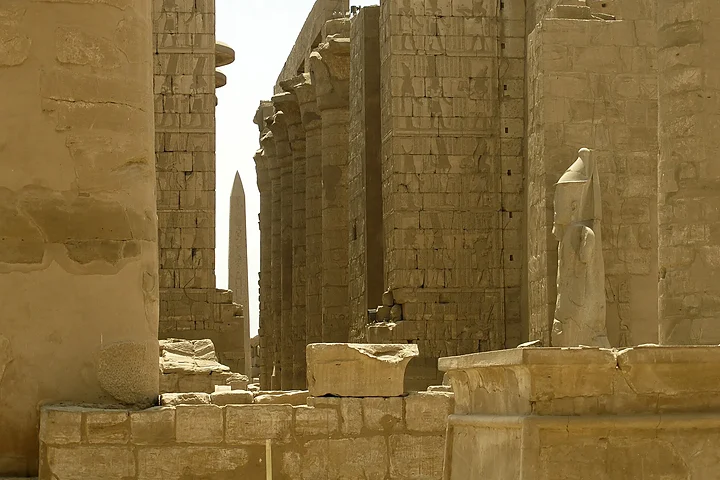
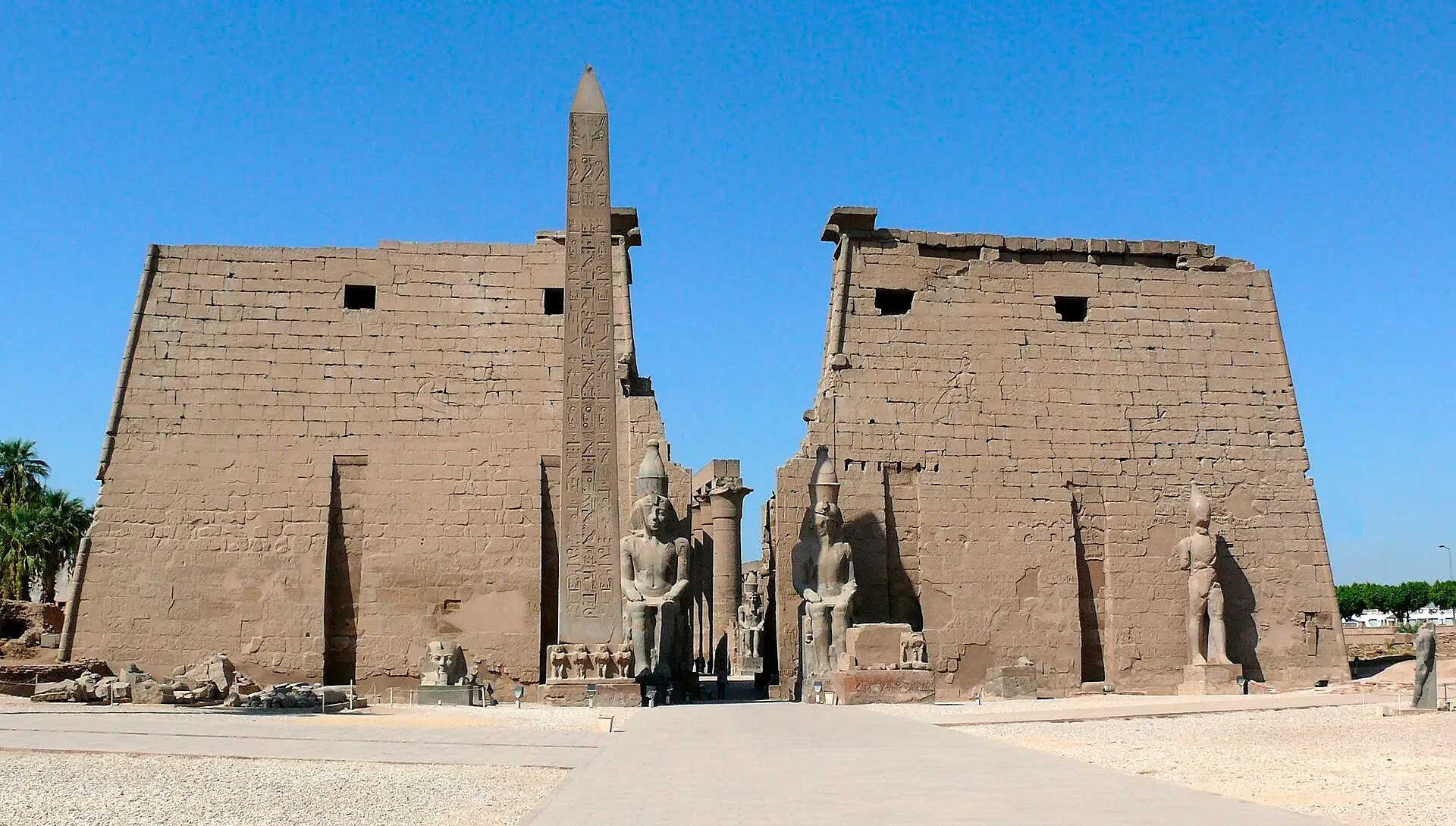
Luksor ibodatxonasi (egip. Jpt-RST "Amun ziyoratgohi") — qadimgi Misr quyosh xudosi Amun-ra Markaziy ibodatxonasining xarobalari, Nil daryosining o'ng qirg'og'ida, Thebesning Janubiy qismida, zamonaviy Luksor shahri chegaralarida.
Ma'bad 1979 yildan beri YUNESKOning Butunjahon merosi ro'yxatiga kiritilgan (Karnak ibodatxonasi va yaqin atrofdagi theban nekropoli bo'lgan guruhda) .
Луксорский храм (егип. Jpt-rst «Святилище Амона») — развалины центрального храма древнеегипетского солнечного бога Амона-Ра, на правом берегу Нила, в южной части Фив, в пределах современного города Луксор.
The Luxor Temple (Arabic: معبد الأقصر) is a large Ancient Egyptian temple complex located on the east bank of the Nile River in the city of Luxor (ancient Thebes) and was constructed around 1400 BC. In Egyptian it was known as ipet resyt, "the southern sanctuary". It was one of the two primary temples on the east bank, the other being Karnak.
Unlike the other temples in Thebes, Luxor temple is not dedicated to a cult god or a deified version of the pharaoh in death. Instead, Luxor temple is dedicated to the rejuvenation of kingship; it may have been where many of the pharaohs of Egypt were crowned in reality or conceptually (as in the case of Alexander the Great, who claimed he was crowned at Luxor but may never have traveled south of Memphis, near modern Cairo).
Der Luxor-Tempel (altägyptisch Ipet-reset) ist eine Tempelanlage im heutigen Luxor in Ägypten. Er wurde zur Zeit des Neuen Reichs (1550 bis 1070 v. Chr.) errichtet und südlicher Harem des Amun von Karnak genannt. Er war dem Gott Amun, seiner Gemahlin Mut und ihrem gemeinsamen Sohn, dem Mondgott Chons, geweiht.
Le temple d'Amon à Louxor ou Opet du sud est un temple égyptien voué au culte d'Amon. Situé au cœur de l’ancienne Thèbes, il fut construit pour l’essentiel sous les XVIIIe et XIXe dynasties. Il était consacré au dieu dynastique Amon sous ses deux aspects d’Amon-Rê céleste et d'Amon-Min (divinité ithyphallique). Les parties les plus anciennes actuellement visibles remontent à Amenhotep III et à Ramsès II. Par la suite, de nouveaux éléments furent ajoutés par Chabaka, Nectanébo Ier et les Lagides.
El templo de Luxor, situado en el corazón de la antigua Tebas, fue construido esencialmente bajo las dinastías XVIII y XIX egipcias. Estaba consagrado al dios Amón bajo sus dos aspectos de Amón-Ra (Ra, era considerado el dios del cielo, dios del Sol y del origen de la vida en la mitología egipcia). Las partes más antiguas actualmente visibles remontan a Amenhotep III y a Ramsés II. Seguidamente, nuevos elementos fueron añadidos por Shabako, Nectanebo I y la dinastía ptolemaica. En época romana, el templo fue parcialmente transformado en campo militar.
Luksor Tapınağı, bugün Luksor olarak bilinen şehirde Nil Nehri'nin doğu kıyısında bulunan büyük bir Eski Mısır tapınak kompleksidir ve yaklaşık MÖ 1400 yılında inşa edilmiştir. Mısır dilinde ipet resyt, "güney sığınağı" olarak bilinir. Luksor'da doğu ve batı kıyılarında birkaç büyük tapınak vardır. Erken gezginlerin ziyaret ettiği büyük morg tapınaklarından dördü Gurnah'daki I. Set Tapınağı, Deyrü'l Bahri'deki Hatşepsut Tapınağı, II. Ramses'in Tapınağı ve Medinet Habu'daki III. Ramses Tapınağı; doğu kıyısındaki iki ana kült tapınağı Karnak ve Luksor olarak bilinir.
卢克索神庙(Luxor Temple)位于埃及卢克索的尼罗河东岸,即古埃及新王国时期的首都底比斯,大约建于公元前十四世纪。
Manba: Vikipediya – “Luksor ibodatxonasi” · CC BY-SA 4.0
Boshqa tillarda o‘qish: · · · · · · ·