Bu matn hozircha boshqa tilda mavjud.
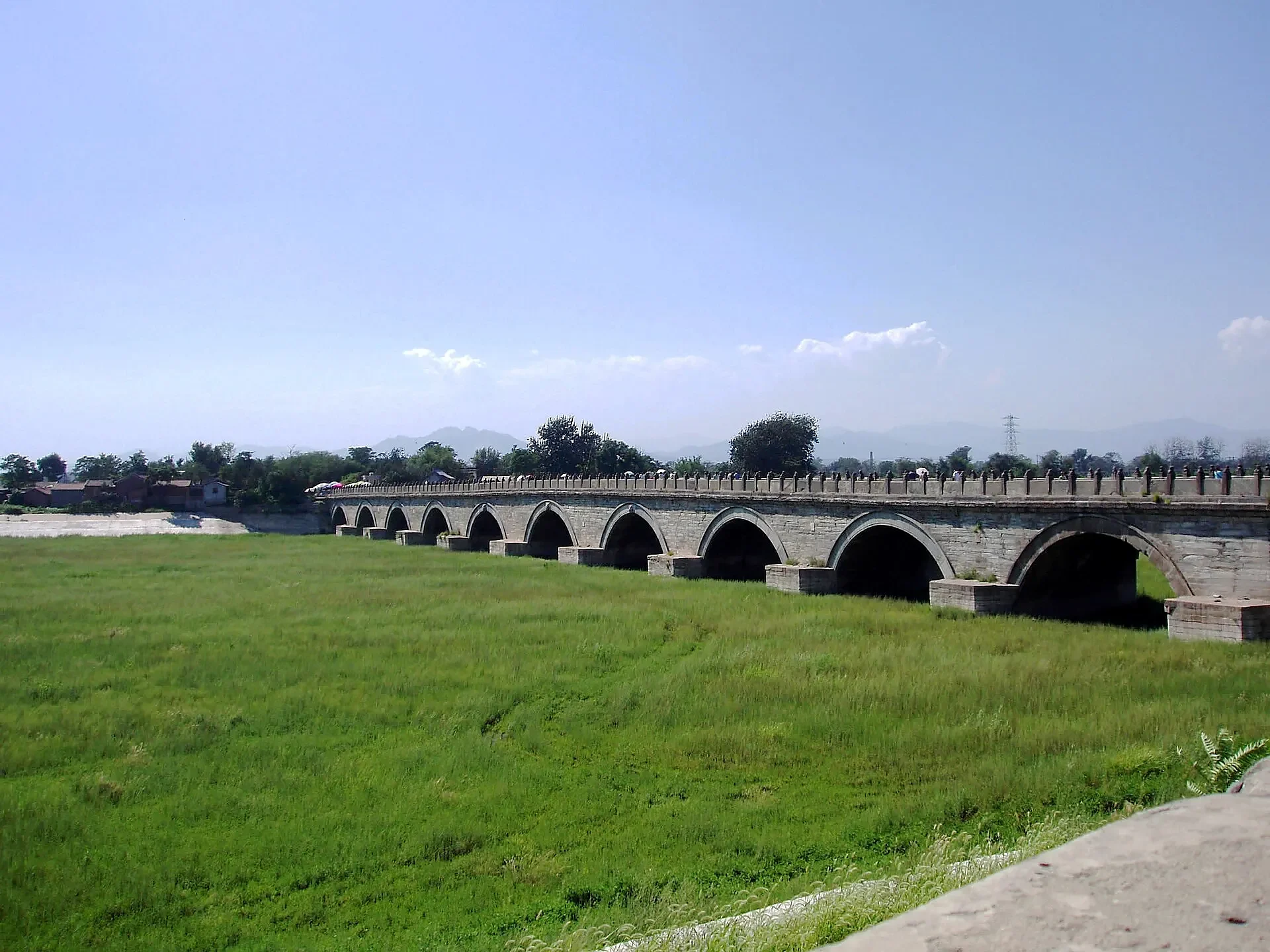
The Marco Polo Bridge or Lugou Bridge (simplified Chinese: 卢沟桥; traditional Chinese: 盧溝橋; pinyin: Lúgōu Qiáo) is a stone bridge located 15 km southwest of Beijing's city center in the Fengtai District. It bridges the Yongding River, a major tributary of Hai River. Situated at the eastern end of the bridge is the Wanping Fortress, a historic 17th-century fortress, with the Museum of the War of Chinese People's Resistance Against Japanese Aggression inside.
The Marco Polo Bridge is well known because it was highly praised by the Venetian traveler Marco Polo during his visit to China in the 13th century (leading the bridge to become known in Europe simply as the Marco Polo Bridge), and for the 20th-century Marco Polo Bridge Incident, which marked the beginning of the Second Sino-Japanese War (1937–1945).
In recent years, the water of Yongding River has been diverted to different areas of Beijing, so there is often no water under the bridge.
Die Marco-Polo-Brücke oder Lugou Qiao (chinesisch 蘆溝橋 / 卢沟桥, Pinyin Lúgōuqiáo – „Schilfrohrgossenbrücke, Schilfrohrgrabenbrücke“) ist eine steinerne Bogenbrücke im Pekinger Stadtbezirk Fengtai, die den Fluss Yongding He überspannt. Sie wurde im Jahre 1192 vollendet.
Le pont Marco-Polo, aussi appelé pont de Lugou ou Lou-Kou-Chiao (chinois simplifié : 卢沟桥 ; chinois traditionnel : 盧溝橋 ; pinyin : Lúgōu Qiáo), est un célèbre pont de pierre situé à 15 km du centre de Pékin dans le district de Fengtai, et enjambant la rivière Yongding. Le pont de Lugou est surtout connu pour son évocation par le voyageur vénitien Marco Polo pendant son voyage en Chine au XIIIe siècle, d'où l'appellation occidentale de pont Marco-Polo, et pour l'incident du pont Marco-Polo, qui marqua le début de la seconde guerre sino-japonaise.
El puente de Marco Polo o puente de Lugou (en chino tradicional, 盧溝橋; en chino simplificado, 卢沟桥; pinyin, Lúgōu Qiáo) es un célebre puente de piedra granítica que se encuentra ubicado a 15 kilómetros a las afueras de la capital china, Pekín (Beijing), y que sirve para unir las dos orillas del Río Hai (río Yongding). El puente es mencionado con admiración en el libro Los viajes de Marco Polo, escrito por Rustichello de Pisa y dictado a este por Marco Polo, razón por la cual en Occidente fue conocido con el nombre de "puente de Marco Polo".
El puente de Lugou fue también el escenario del incidente histórico que desencadenó la Segunda Guerra Sino-japonesa, dentro de la Segunda Guerra Mundial.
Marco Polo Köprüsü (Çince: 卢沟桥; pinyin: Lúgōu Qiáo), Çin'ın başkenti Pekin'de Yongding Nehri üzerinde bulunan bir taş köprüdür. Köprü, şehir merkezinden 15 km güneybatısında Fengtai semtinde Wanping Kalesi'nin yanında yer almaktadır.
Marco Polo Köprüsü ilk olarak 1192 yılında Jin Hanedanı döneminde inşa edilmiş olup 1698'de Qing Hanedanı döneminde sel nedeniyle zarar görmesi üzerine onarılmıştır. Köprü özellikle Venedikli gezgin Marco Polo tarafından övülmüştür ve bu nedenle batıda Marco Polo Köprüsü olarak adlandırılmaktadır. Aynı zamanda İkinci Çin-Japon Savaşı'nın başlangıcı sayılan Marco Polo Köprüsü Olayı burada yaşanmıştır.
Son yıllarda, Yongding Nehri suyunun Pekin'in farklı bölgelerine yönlendirilmesi sonucunda köprü altında çok sık akıntı olmamaktadır.
卢沟桥,新中国前多称芦沟桥,金朝建成时名为广利桥,近代欧洲又称之马可波罗桥,位于中华人民共和国北京市丰台区的永定河上,东距宛平城170米,因横跨卢沟河(即永定河)而得名,是北京市现存古老的石造联拱桥,被誉为“中国古代四大名桥之一”。始建于金大定二十九年(1189年),明昌三年(1192年)完工,明清两代多有维修改建。该桥自建成后即为交通要道,桥头曾设有税课司。1937年,日军以一名演习士兵失踪为由要求进入宛平城搜查,被守城中国军队拒绝后围攻宛平城和卢沟桥,卢沟桥事变爆发,是为中国抗日战争转向全面抗战的标志性事件。中华人民共和国成立后,一度将该桥改为公路桥,1987年恢复为石桥,并停止该桥交通功能,改为文物景点。该桥为东西走向,全长268米,宽9.4米,桥上设有石栏和望柱,望柱顶端雕刻有数量不一的石狮子。桥的两侧建有华表,并立有碑刻。1961年,卢沟桥列入全国重点文物保护单位,与卢沟桥相关的传说则以“卢沟桥传说”一名于2014年入列国家级非物质文化遗产名录。门票收费20元。
Manba: Vikipediya – “Marco Polo Bridge” · CC BY-SA 4.0
Boshqa tillarda o‘qish: · · · · ·