Bu matn hozircha boshqa tilda mavjud.
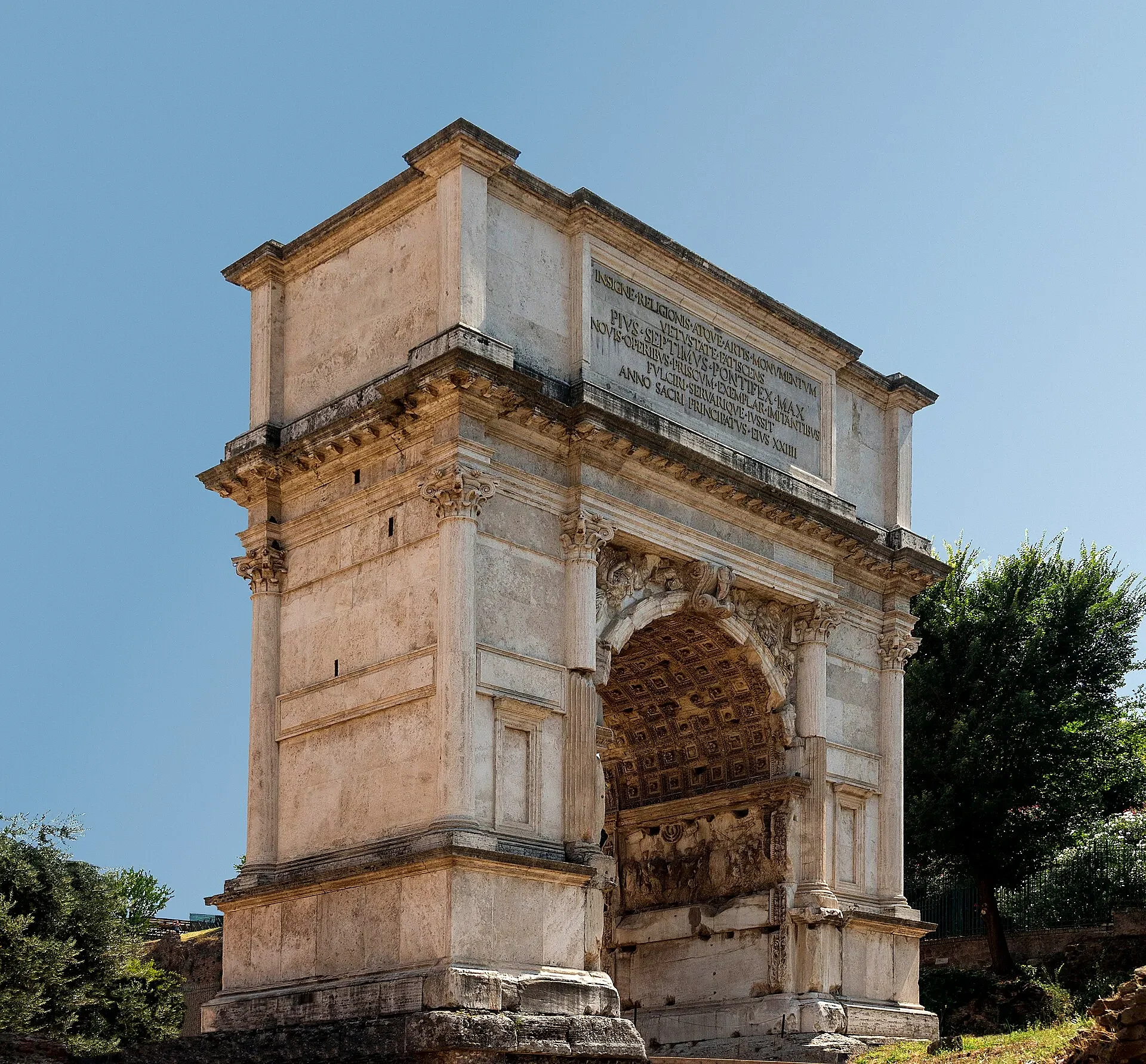
The Arch of Titus (Italian: Arco di Tito; Latin: Arcus Titī) is a 1st-century AD honorific arch, located on the Via Sacra, Rome, just to the south-east of the Roman Forum. It was constructed in c. 81 AD by Emperor Domitian shortly after the death of his older brother Titus to commemorate Titus's official deification or consecratio and the victory of Titus together with their father, Vespasian, over the Jewish rebellion in Judaea.
The arch contains panels depicting the triumphal procession celebrated in 71 AD after the Roman victory culminating in the fall of Jerusalem, and provides one of the few contemporary depictions of artifacts from Herod's Temple. Although the panels are not explicitly stated as illustrating this event, they closely parallel the narrative of the Roman procession described a decade prior in Josephus's The Jewish War.
It became a symbol of the Jewish diaspora, and the menorah depicted on the arch served as the model for the menorah used as the emblem of the State of Israel.
Триумфальная арка Тита (итал. Arco di Tito, лат. Arcus Tītī) — однопролётная триумфальная арка, расположенная на древней Священной дороге (лат. Via Sacra) к юго-востоку от Римского форума. Построена императором Домицианом вскоре после смерти императора Тита в 82 году н. э. в память о взятии Иерусалима в ходе Первой иудейской войны в 70 году н. э. Арка послужила классическим образцом для многих подобных сооружений Нового времени.
В Риме была и другая арка Тита, трёхпролётная, воздвигнутая Сенатом в 81 году н. э. в восточной оконечности Большого Цирка.
Арка широко известна, прежде всего, барельефами, на которых изображено триумфальное шествие с трофеями, захваченными римлянами в Иерусалиме. Барельефы представляют собой одно из немногих сохранившихся изображений артефактов из уничтоженного римлянами храма царя Ирода в Иерусалиме.
Der Titusbogen (italienisch Arco di Tito) ist ein eintoriger Triumphbogen auf der Velia, einem Hügel in Rom. Er ist der älteste erhaltene Triumphbogen der antiken Stadt und gehört heute zum archäologischen Gelände des Forum Romanum und des Palatin. Er ist Vorbild anderer Triumphbögen, so auch des Arc de Triomphe in Paris.
L'arc de Titus (en latin : Arcus Titi) est un arc de triomphe romain à un balcon, érigé dans Rome par l’empereur Domitien en 81 ap. J.-C. pour célébrer les victoires de son frère Titus durant la guerre de Judée entre 66 et 73 ap. J.-C, notamment le siège de Jérusalem de 70 apr.J.-C. par son armée. Ce monument a servi de modèle à de nombreux arcs érigés par la suite.
El arco de Tito (en italiano Arco di Tito; en latín, Arcus Titi) es un arco honorífico, situado en la Vía Sacra, justo al sureste del Foro, en Roma. Fue construido hacia el año 80 d. C. por el emperador romano Domiciano poco después de la muerte de su hermano mayor, Tito, para conmemorar las victorias de este, incluido el Sitio de Jerusalén del 70 d. C. El arco ha proporcionado el modelo general para muchos arcos triunfales erigidos desde el siglo XVI, y es lo que inspiró el Arco de Triunfo en París, Francia.
提图斯凯旋门(意大利语:Arco di Tito; 拉丁语:Arcus Titi),是位于意大利罗马古罗马广场东南圣道上的一座大理石单拱凯旋门,是1世纪的敬意拱门,建于公元81年。由图密善皇帝在兄长提图斯去世后不久兴建,纪念提图斯在公元70年征服和摧毁耶路撒冷,终止了自公元66年开始的犹太人大起义。拱门上的镶板描绘了公元71年罗马胜利、耶路撒冷陷落后庆祝的凯旋游行。它成为犹太人散居的象征,拱门上描绘的灯台亦成为以色列国徽灯台的原型。
提图斯凯旋门是16世纪以后竖立的许多凯旋门所仿效的原型——也许最著名的是它是法国巴黎凯旋门的灵感来源。
提图斯凯旋门坐落在Velian山,旁边即是罗马斗兽场。Velian在帕拉丁和Esquiline山的中间,罗马广场的东南部。提图斯凯旋门本身有13.50米宽,高15.40和4.75深,而内在的的牌楼是高8.30米,和5.36宽。而它的建筑材料是使用使用潘泰列克大理石。
Manba: Vikipediya – “Arch of Titus” · CC BY-SA 4.0
Boshqa tillarda o‘qish: · · · · ·