Bu matn hozircha boshqa tilda mavjud.
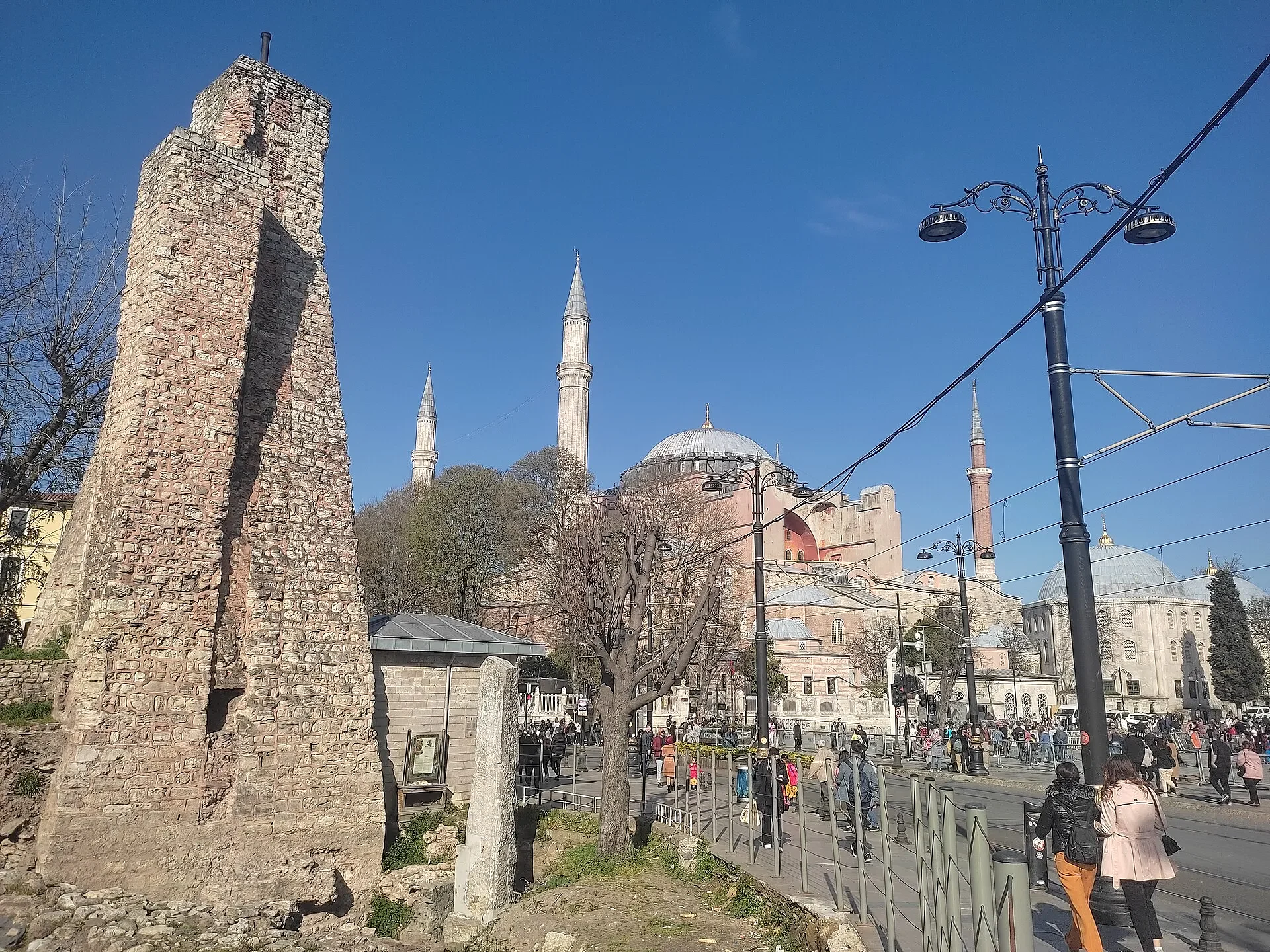
The Milion (Ancient Greek: Μίλιον or Μίλλιον, Mílion; Turkish: Milyon taşı) was a marker from which all distances across the Roman Empire were measured. Erected by Septimius Severus in the 3rd century AD in the city of Byzantium, it became the zero-mile marker for the empire upon the re-founding of the city as Constantinople in 330 AD. Thereafter, it would serve as the starting-place for the measurement of distances for all the roads leading to the cities of the Eastern Roman Empire. It thus served the same function as the Golden Milestone (Milliarium Aureum) in Rome's forum, erected by Augustus. The domed building of the Milion rested on four large arches and, over the centuries, it was expanded and decorated with several statues and paintings. Though it had survived the sack of Constantinople in 1204 and the Ottoman conquest of Constantinople in 1453, it disappeared by the start of the 16th century in the Ottoman era. During excavations in the 1960s, some partial fragments of the Milion were discovered under houses in the area.
Милий, Милион (греч. Μίλ(λ)ιον — мильный камень), Милиарий (лат. Milliarium) — древнее сооружение, находившееся в центре Константинополя, столицы Византийской империи. Являло собой мраморную колонну, стоявшую в центре квадратного здания с пирамидальной крышей (тетрапилона). Выполненная из мрамора колонна выполняла ту же функцию, что и Milliarium Aureum в Риме: от неё отсчитывалась протяженность всех дорог империи. Само здание изначально было украшено многочисленными скульптурами и картинами. Построенный в IV веке при основании города, Милий просуществовал вплоть до начала XVI столетия, когда его снесли захватившие Константинополь турки-османы. В 1960-х годах, в ходе раскопок недалеко от собора Святой Софии были обнаружены остатки одной из несущих конструкций тетрапилона. Ныне этот фрагмент выставлен в северном дворе собора в стамбульском районе Фатих, недалеко от Большой цистерны.
Das Milion (altgriechisch Μίλ(λ)ιον) war Monument und Meilenstein in einem. Es wurde im frühen 4. Jahrhundert n. Chr. in Konstantinopel (heute Istanbul, Türkei) errichtet. Das Milion war der Ausgangspunkt aller Messungen für Meilensteine an Straßen, die zu den wichtigen Städten des Oströmischen Reiches führten, und hatte dieselbe Funktion wie das Milliarium Aureum von Rom.
Das Gebäude des Milion war wahrscheinlich ein Tetrapylon. Vier große Bögen trugen eine Kuppel und es war von zahlreichen Statuen und Gemälden geschmückt. Es überlebte die osmanische Eroberung von Konstantinopel 1453 für fünfzig Jahre, verschwand aber am Anfang des 16. Jahrhunderts. Während Ausgrabungen in den 1960er Jahren wurden Bruchstücke des Milion unter den Häusern der Umgebung gefunden.
Érigé au IVe siècle, le Milion ou Million (Μίλιον ou Μίλλιον en grec, Milyon taşı en turc) est un monument qui marquait, à Constantinople, le point de départ des routes conduisant aux différentes villes de l’empire. Il avait la même fonction que le Milliaire d'or (Millarium Aureum) à Rome. Surmonté d’un dôme, le Milion était un édifice quadrangulaire constitué de quatre arcs monumentaux et décoré de nombreuses statues et peintures. Il survécut à la conquête de Constantinople en 1453, mais disparut au début du XVIe siècle. Des fragments furent retrouvés lors d’excavations dans les années 1960.
El Milion (en griego: Μίλ(λ)ιον), es un miliario erigido a principios del siglo IV d. C. en Constantinopla. Este monumento marcaba el origen desde el que se medían las distancias de todas las carreteras que llevaban al resto de las ciudades del Imperio Bizantino. Es el equivalente en Constantinopla al Milliarium Aureum ("Miliario de Oro") ubicado en el Foro de Roma.
Milyon taşı (Yunanca: Μίλ(λ)ιον / Milion), İstanbul'da Doğu Roma döneminde 4. yüzyılda dikilmiş bir anıttır.
道路原点(古希腊语:Μίλιον),又译米利安,是拜占庭帝国所有距离的测量标记,由塞普蒂米乌斯·塞维鲁在西元三世纪修建在拜占庭城内。拜占庭扩建成君士坦丁堡后,成为罗马帝国的道路原点,取代了位于罗马的金色里程碑的地位。这一建筑保存至16世纪初期。
Manba: Vikipediya – “Milion” · CC BY-SA 4.0
Boshqa tillarda o‘qish: · · · · · ·