Buyuk Sfinks
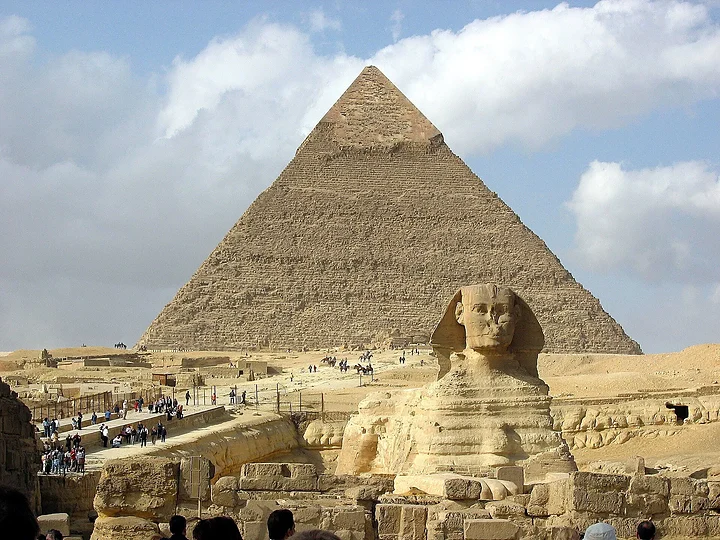
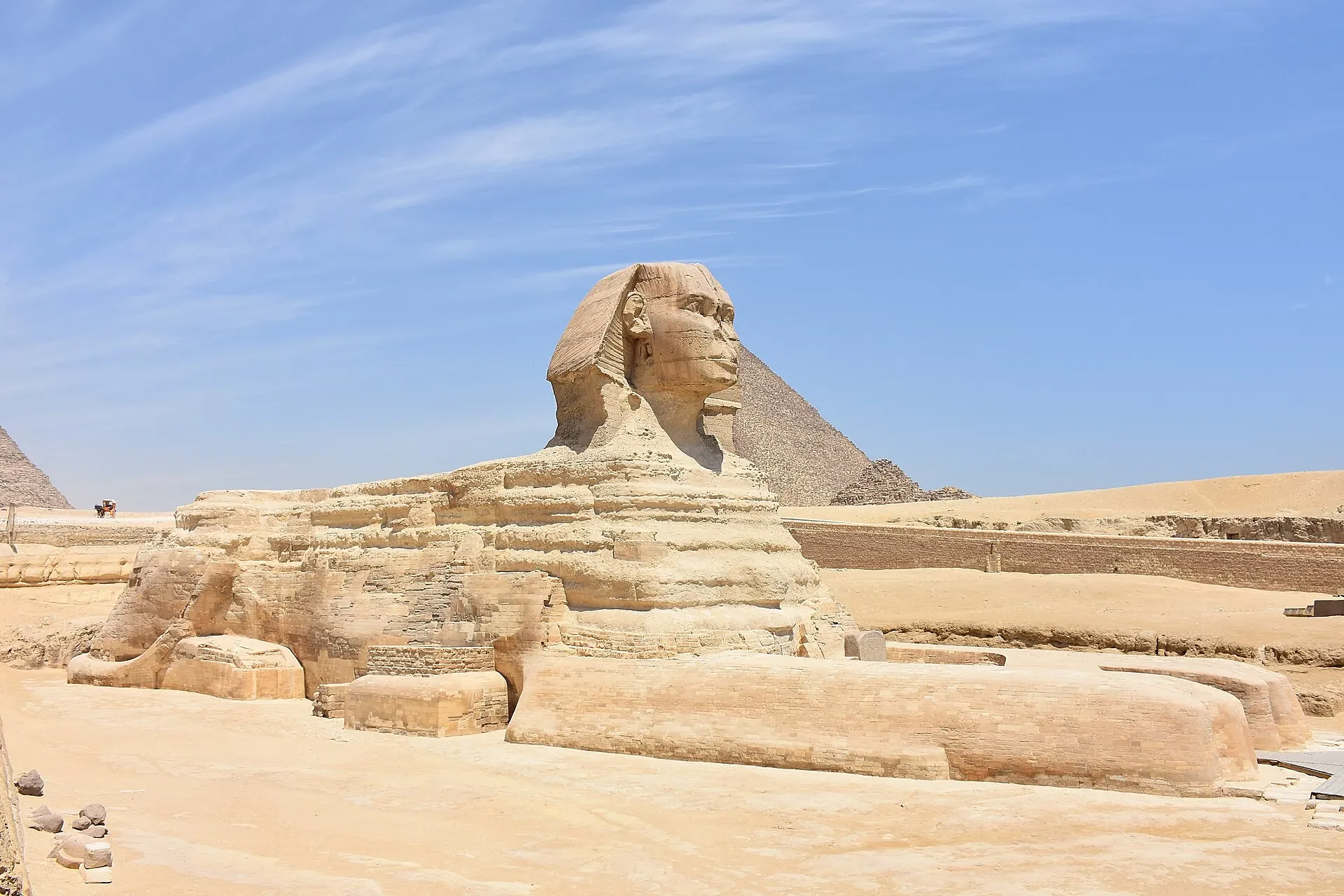
Buyuk Sfinks – Nil ning gʻarbiy qirgʻogʻida Giza shahrida joylashgan boʻlib u yer yuzida saqlanib qolgan eng qadimgi monumental haykal hisoblanadi.
Monolit ohak tosh qoyadan ulkan sfinks shaklida oʻyilgan-qum ustida yotgan sher boʻlib, uning yuziga Firʼavn Xefren (miloddan avvalgi 2575-2465 yillar) bilan portret oʻxshashligi berilgan va uning dafn piramidasi yaqin joylashgan. Haykalning uzunligi 73 metr, balandligi 20 metr boʻlib, uni dunyodagi eng katta bitta toshli haykalga aylantiradi. Old oyoqlari orasida kichik muqaddas joy joylashgan.
Большой сфинкс на западном берегу Нила в Эль-Гизе — древнейшая сохранившаяся на Земле монументальная скульптура. Высечена из монолитной известковой скалы в форме колоссального сфинкса, лежащего на песке, лицу которого, как издавна принято считать, придано портретное сходство с фараоном Хефреном (ок. 2575—2465 гг. до н.
The Great Sphinx of Giza (Arabic: أبو الهول, romanized: ʾabū al-Hawl) is a limestone statue of a resting sphinx, a mythical creature with the head of a human and the body of a lion. The monument was sculpted from the limestone bedrock of the Eocene-aged Mokattam Formation and faces east on the Giza Plateau, on the west bank of the Nile in Giza, Egypt. The oldest known monumental sculpture in Egypt, the Sphinx is part of the Memphite Necropolis and is a UNESCO World Heritage Site.
Archaeological evidence suggests the Sphinx was created by Egyptians of the Old Kingdom during the reign of Khufu (c. 2590–2566 BC) or Khafre (c. 2558–2532 BC).
Die (auch der) Große Sphinx von Gizeh in Ägypten (arabisch أبو الهول, DMG Abū l-Haul) ist die mit Abstand berühmteste und größte Sphinx. Sie stellt einen liegenden Löwen mit einem Menschenkopf dar und wurde vermutlich in der 4. Dynastie während der Herrschaft von Chephren (um 2520 bis 2494 v. Chr., nach anderen Angaben 2570 bis 2530 v.
Le Sphinx de Gizeh est la statue thérianthrope qui se dresse devant les grandes pyramides du plateau de Gizeh, en Basse-Égypte.
Sculpture monumentale monolithique la plus grande du monde avec 73,5 mètres de longueur, 14 mètres de largeur et 20,22 mètres de hauteur, elle représente un sphinx couchant. Réalisée vers 2500 av. J.-C., elle est attribuée à Khéphren, l'un des pharaons de la IVe dynastie de l'Ancien Empire, ou à son père, Khéops.
La Gran Esfinge de Guiza es una escultura monumental que se encuentra en la ribera occidental del río Nilo, en la meseta de Guiza, unos veinte kilómetros al suroeste del centro de El Cairo, en Egipto. Los egiptólogos estiman que fue esculpida ca. s. XXVI a.
Büyük Gize Sfenksi, Mısır'ın başkenti Kahire'de, Gize piramitleri bölgesinde yer alan bir sfenks heykelidir.
Dünyadaki en büyük tek-taş heykeli olup 73.5 metre uzunluğunda, 19 metre genişliğinde ve 20 metre yüksekliğindedir. Pençelerinin arasında bir tapınak olan ve yatan aslan biçiminde kafası ile bir firavun başı şeklinde olan bir heykeldir. Aslanlar Antik Mısır mitolojisinde kutsal sayıldıkları için kutsallık ve büyü güçlerini kullanarak firavun mezarlarını ve piramitleri koruması amacıyla inşa edildiği düşünülmektedir.
人面獅身像(埃及阿拉伯語:أبو الهول,羅馬化:Abū il-Hawl;古希臘語:Σφίγξ,羅馬化:Sphinx,英語:Great Sphinx of Giza;圣书体:𓊏𓊪𓀾𓋹𓈖𓐍)或稱獅身人面像,是埃及文化遗产,位於卡夫拉金字塔旁的雕像,外型是一個獅子的身軀和人的頭。獅身人面像長約73.5米(241英尺),寬約19.3米(63英尺),高約20.22米(66.34英尺)。獅身人面像是現今已知最古老的紀念雕像,一般相信是在法老卡夫拉統治期內(約公元前2558年至2532年)建成。
由於獅身人面像無論是年代、外型,甚至是建造者是誰都充滿爭議,所以這些問題被世人稱作「獅身人面像之謎」,但與希臘神話中的史芬克斯之謎仍有些許不同。
Manba: Vikipediya – “Katta sfinks” · CC BY-SA 4.0
Boshqa tillarda o‘qish: · · · · · · ·