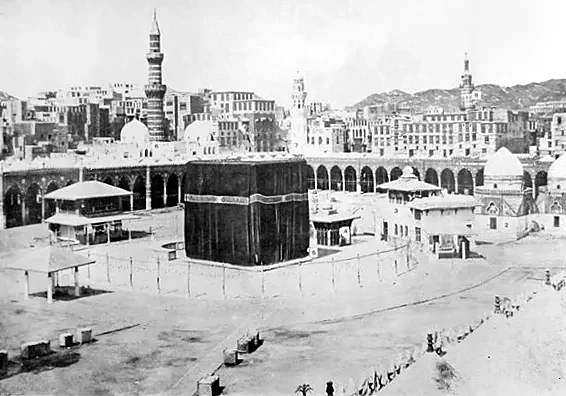
al-Masjid al-Haram (arabcha: المسجد الحرام „Muqaddas Masjid“) — dunyodagi eng katta masjid, Makkadagi Kaʼba ibodatxonasi va u bilan bogʻliq boʻlgan majmua. Ushbu masjid Makka shahrida boʻlib musulmonlar namoz qilganda yuzlanadigan hamda musulmonlar tarafidan dunyogagi eng muqaddas joy deb bilingan Kaʼbani oʻrab olgan. Ushbu masjid „Haram“ yoki „Haram Sharif“ deb ham tilga olinadi.
Qurʼonda shu nom bilan tilga olingan.
Мече́ть аль-Хара́м (араб. المسجد الحرام — Аль-Масджиду-ль-Харам «Запове́дная мечеть» или «Запретная мечеть») — главная и крупнейшая в мире мечеть, во внутреннем дворе которой находится главная святыня ислама — Кааба. Расположена в Мекке, в Саудовской Аравии. Посещение мечети аль-Харам и Каабы является обязательным элементом паломничества (хаджа).
Masjid al-Haram (Arabic: المسجد الحرام, romanized: al-Masjid al-Ḥarām, lit. 'The Sacred Mosque'), also known as the Great Mosque of Mecca, is a mosque in Mecca, Saudi Arabia, serving as the holiest and most important mosque in Islam. As of 2026, the Great Mosque is the largest mosque in the world.
The Great Mosque is considered, alongside the Quba Mosque in Medina, among the earliest mosques in Islam. According to Islamic scholars, Abraham is seen as having built the Kaaba in Mecca, and consequently its sanctuary, which according to the Muslim view is seen as the first mosque that ever existed.
Die al-Harām-Moschee (arabisch المسجد الحرام al-Masdschid al-Harām, DMG al-masǧid al-ḥarām), auch Heilige Moschee und Große Moschee genannt, im saudi-arabischen Mekka ist die größte Moschee der Welt. Sie gilt noch vor der Prophetenmoschee in Medina und der al-Aqsa-Moschee in Jerusalem als die vorzüglichste Moschee des Islams. In ihrem Hof befinden sich die Kaaba, das zentrale Heiligtum des Islams, der Zamzam-Brunnen und der Maqām Ibrāhīm. Eine Besonderheit der al-Harām-Moschee ist, dass hier nicht nur wie in anderen Moscheen Gebet und Chutba stattfinden, sondern auch der Tawāf, also die rituelle Umkreisung der Kaaba.
La mosquée al-Haram (en arabe : الْمَسْجِدُ ٱلْحَرَام, al-Masjid al-Ḥaram, « la Mosquée sacrée »), ou grande mosquée de la Mecque, est une mosquée à La Mecque, en Arabie saoudite. Elle est le premier lieu saint de l'islam et la plus grande mosquée du monde, qui abrite en son centre la Kaaba, le plus important sanctuaire de l'islam, dans lequel est enchâssée la pierre noire. C'est elle que les musulmans tentent de toucher au cours des ṭawāf (circumambulations) qu'ils accomplissent durant leur pèlerinage (hajj) et c'est dans la direction de la Kaaba que les musulmans du monde entier (y compris ceux qui se trouvent dans la mosquée al-Haram) se tournent pour prier.
La mosquée al-Haram est un sanctuaire bâti dans un deuxième temps afin d'abriter ce sanctuaire préexistant de la Kaaba, qui est un bâtiment qui existait avant l'apparition de l'islam.
La Gran Mezquita de La Meca, conocida en árabe como al-Másyid al-Haram (en árabe: اَلْمَسْجِدُ ٱلْحَرَامُ, lit. 'La mezquita sagrada'), es la mezquita más grande del mundo. Está situada en la ciudad de La Meca (Arabia Saudita) y su patio central contiene la Kaaba, el lugar más sagrado del islam. En la Kaaba se halla la Piedra Negra que los musulmanes tratan de tocar en el curso de las circunvalaciones durante la peregrinación (el Hach).
Mescid-i Haram (Arapça: ُاَلْمَسْجِد اَلْحَرَام), Mekke'de Kâbe’nin de içinde bulunduğu alanı çevreleyen büyük mescittir. Hürmetli Mescid anlamına gelen bu ifade Kur'an'da 16 ayette yer almaktadır.
Taifte bulunan bir taş yazıt Mescid-i Haram'ın yapılış tarihini Hicret'ten sonra 78 veriyor.
Mescid-i Haram'ın ortasında bulunan Kâbe'nin doğu köşesine işaret taşı olarak farklı renk ve özelliğe sahip olan "Kara Taş" anlamına gelen Hacer-ül Esved yerleştirilmiş ve gümüş bir çerçeveyle çevrilmiştir.
禁寺(阿拉伯語:اَلْمَسْجِدُ ٱلْحَرَام,羅馬化:Al-Masjidu al-Ḥarām),又譯麥加禁寺、麥加大清真寺,是位於沙烏地阿拉伯城市麥加的清真寺,它是全球穆斯林的每日的朝拜方向,也是伊斯蘭教最神聖的地方。禁寺有25个大门和13个高大宣礼塔,以克尔白(天房)为中心,面積達356800平方公尺,约可同時容納400萬人禮拜。其阿拉伯語原名的意思為「禁止(暴力行為)的清真寺」。
截至2020年8月,禁寺是世界上最大的清真寺和第八大建築。
Manba: Vikipediya – “Al-Masjid al-Harom” · CC BY-SA 4.0
Boshqa tillarda o‘qish: · · · · · · ·