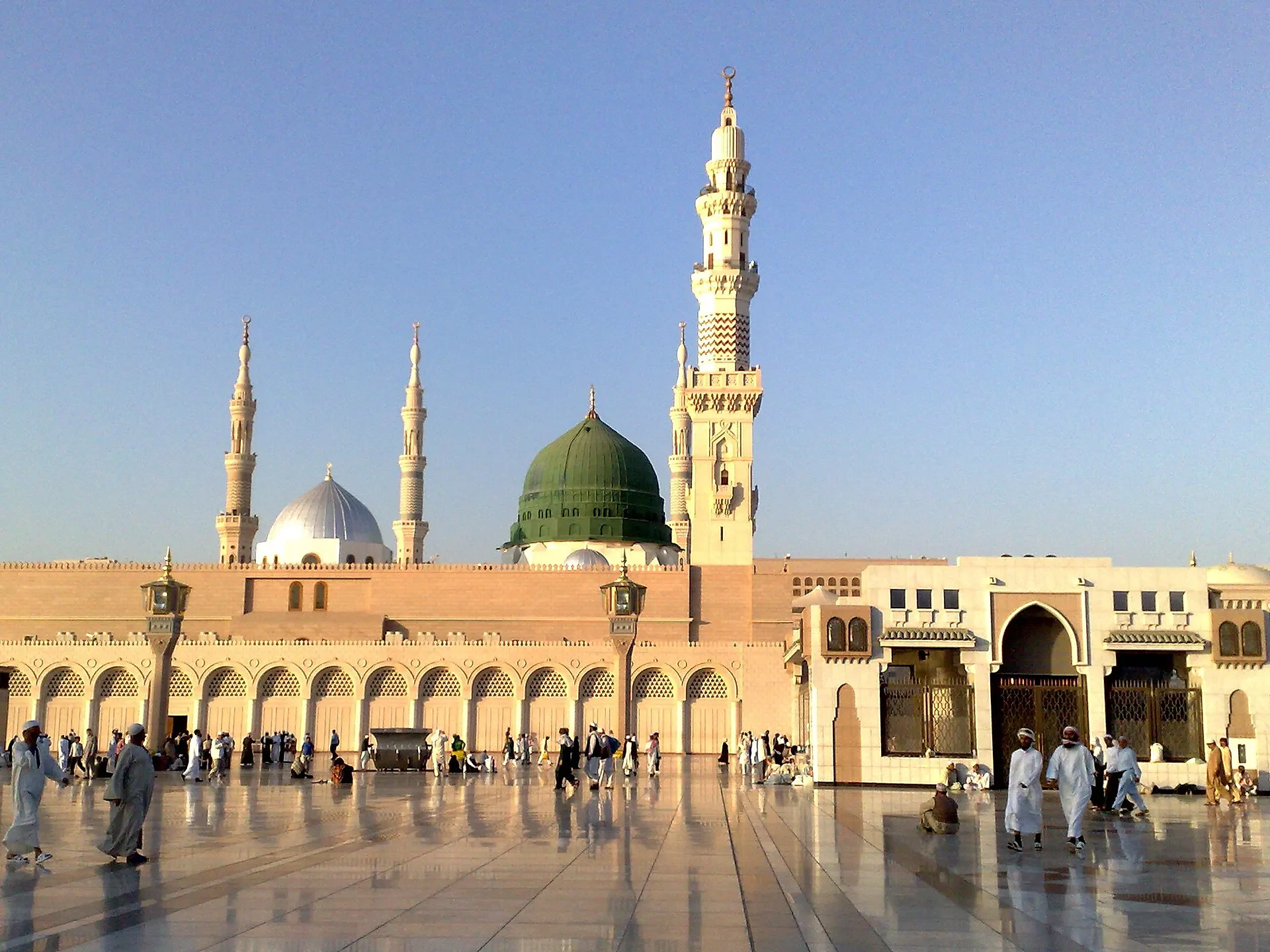
Masjid al-Nabaviy (arabcha: المسجد النبوی tarj. "Paygʻambar masjidi") - Islom dinidagi ikkinchi muqaddas masjid. Saudiya Arabistonining Madina shahrida joylashgan. Ushbu masjid ilk bor Muhammad paygʻambar tomonidan qurilgani bois shunday ataladi.
Аль-Масджи́д ан-Набави́ (араб. المسجد النبوي — Мечеть Пророка) — вторая святыня ислама после мечети аль-Харам в Мекке. Является второй самой крупной мечетью в мире. Место погребения пророка Мухаммеда.
The Prophet's Mosque (Arabic: ٱلْمَسْجِد ٱلنَّبَوِي, romanized: al-Masjid al-Nabawī, lit. 'Mosque of the Prophet') is the second mosque built by the Islamic prophet Muhammad in Medina, after the Quba Mosque, as well as the second largest mosque and holiest site in Islam, after the Masjid al-Haram in Mecca, in the Saudi region of the Hejaz. The mosque is located at the heart of Medina, and is a major site of pilgrimage that falls under the purview of the Custodian of the Two Holy Mosques.
Muhammad himself was involved in the construction of the mosque. At the time, the mosque's land belonged to two young orphans, Sahl and Suhayl, and when they learned that Muhammad wished to acquire their land to build a mosque, they went to Muhammad and offered the land to him as a gift; Muhammad insisted on paying a price for the land because they were orphaned children.
Die Prophetenmoschee (arabisch المسجد النبوي al-Masdschid an-Nabawi, DMG al-masǧid an-nabawī) in Medina ist nach der al-Harām-Moschee in Mekka die zweitheiligste Moschee im Islam. Für Nicht-Muslime ist sie nicht zugänglich. Im Inneren befindet sich die Grabstätte Mohammeds, errichtet über seinem Wohnhaus.
La mosquée du Prophète (en arabe : المسجد النبوي Al-Masjid Al-Nabawi) à Médine, en Arabie saoudite, est la deuxième mosquée la plus sainte de l'islam après Masjid al-Haram à La Mecque et avant la mosquée d'Al-Aqsa (à côté du Dôme du Rocher), à Jérusalem.
La mosquée originale a été construite par Mahomet. Les califes suivants l'ont agrandie et ont amélioré sa décoration. Le premier édifice n'était pas grand et ne représentait qu'une petite partie de la superficie du bâtiment actuel.
La Mezquita del Profeta (en árabe: المسجد النبوي Al-Masŷid an-Nabawī) es una mezquita establecida y construida originalmente por el profeta islámico Mahoma, ubicada en Medina, en la región de Hiyaz en Arabia Saudita. Fue la tercera mezquita construida en la historia del Islam y ahora es una de las más grandes del mundo. Es la segunda mezquita más sagrada del islam —entre la Gran Mezquita de La Meca y la mezquita de Al-Aqsa (al lado de la Cúpula de la Roca, en Jerusalén)—. La mezquita original fue construida por el profeta Mahoma. Los siguientes califas aumentaron el tamaño y la decoración de la mezquita.
Mescid-i Nebevî, Mescid-i Nebi ya da Peygamber Mescidi (Arapça: المسجد النبوي), Hicret'ten sonra Medine'de İslam peygamberi Muhammed ile arkadaşları tarafından inşa edilen, Muhammed'in kabrinin de içerisinde bulunduğu mescit. "Nebevi" Arapçada "peygambere ait" anlamına gelir, "Mescid-i Nebevî" tamlamasının anlamı ise "Peygamber Mescidi"dir. Mekke'de bulunan Mescid-i Haram'dan sonra Müslümanlara göre ikinci en kutsal mescittir.
Mescid-i Nebevî ya da Mescid-i Nebi ilk inşasında basit yapılıydı.
先知清真寺一般简称先知寺(المسجد النبوي,羅馬化:Al-Masjid an-Nabawi),又名麦地那清真寺(مسجد المدينة),是一座位于伊斯兰教第二大圣地麦地那的清真寺,是仅次于麦加禁寺的伊斯兰教第二大圣寺,也是伊斯兰教史上继库巴清真寺之后第二座清真寺。
Manba: Vikipediya – “Al-Masjid an-Nabaviy” · CC BY-SA 4.0
Boshqa tillarda o‘qish: · · · · · · ·