
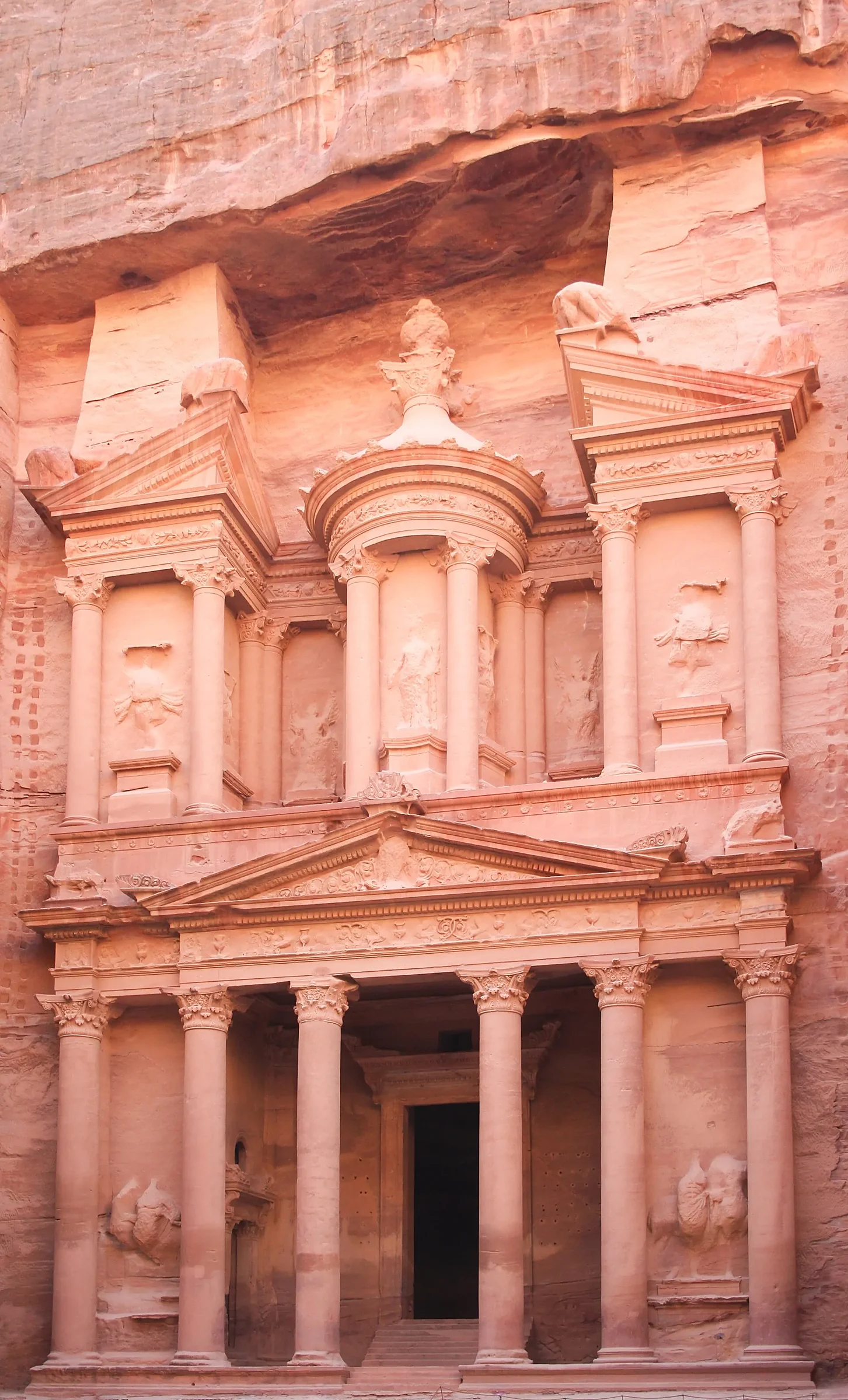
Petra (arabcha: البتراء al-Batrāʼ) – Iordaniyaning janubi-gʻarbiy qismida joylashgan qadimiy shahar. Idumea va keyinchalik Nabateys podsholigining sobiq poytaxti. Dengiz sathidan 900 m dan ortiq balandlikda Siqning tor kanyonida joylashgan. Iordaniya poytaxti Ammandan 236 km uzoqlikda joylashgan.
Пе́тра (араб. البتراء —аль-Батра́, др.-греч. Πέτρα) — древний город, столица Идумеи (Эдома), позже столица Набатейского царства. Сами набатеи называли свой город Rqm (Ракму).
Petra is an ancient city and archaeological site in southern Jordan. Famous for its rock-cut architecture and water conduit systems, Petra is also called the "Rose City" because of the colour of the sandstone from which it is carved. The city is one of the New 7 Wonders of the World and a UNESCO World Heritage Site.
The area around Petra has been inhabited from as early as 7000 BC, and was settled by the Nabataeans, a nomadic Arab people, in the 4th century BC. Petra would later become the capital city of the Nabataean Kingdom in the second century BC. The Nabataeans invested in Petra's proximity to the incense trade routes by establishing it as a major regional trading hub, which gained them considerable revenue.
Petra (altgriechisch Πέτρα [ˈpɛtʁa] „Felsen, Felsmassiv“, arabisch البتراء al-Batrā’, nabatäisch wahrscheinlich Reqmu „die Rote“), eine Ruinenstätte im heutigen Jordanien, war in der Antike die Hauptstadt des Reiches der Nabatäer. Wegen ihrer monumentalen Grabtempel, deren Fassaden direkt aus dem anstehenden Fels gemeißelt wurden, gilt sie als einzigartiges Kulturdenkmal. Am 6. Dezember 1985 wurde Petra in die Liste des UNESCO-Welterbes aufgenommen.
Pétra (du grec ancien : πέτρα (pétra), « rocher » ; en arabe : الْبَتْرَاء (al-Batrāʔ)) est une cité antique, capitale de la Nabatène, située au sud de l'actuelle Jordanie.
La situation de Pétra, dissimulée entre des rochers aux parois abruptes et dotée d'un approvisionnement sûr en eau, en fait un lieu propice au développement d'une cité prospère, comme étape du commerce caravanier. Fondée vers la fin du VIIIe siècle av. J.-C., par les Édomites, elle est ensuite occupée vers le VIe siècle av.
Petra (en griego antiguo, Πέτρα, en árabe, البتراء, al-Batrā´) es un importante enclave arqueológico en Jordania y la capital del antiguo reino nabateo, cuyos pobladores la llamaban Raqmu (en árabe nabateo: الرقيم). El nombre de Petra proviene del griego πέτρα, que significa piedra.
El asentamiento de Petra se localiza en un valle angosto, al este del valle de Arabá que se extiende desde el mar Muerto hasta el golfo de Áqaba. Los restos más célebres de Petra son sin duda sus construcciones labradas en la misma roca del valle (hemispeos), en particular, los edificios conocidos como el Khazneh (‘el Tesoro’) y el Deir (‘el Monasterio’).
Fundada a finales del siglo VIII a.
Petra (Arapça: ٱلْبَتْراء, romanize: Al-Batrāʾ; Grekçe: Πέτρα) veya sakinleri tarafından bilinen ismiyle Raqmu, Ürdün'ün güneyinde yer alan tarihi ve arkeolojik bir şehirdir. Kayaya oyulmuş mimarisi ve su kanalı sistemleriyle ünlü Petra, oyulduğu kumtaşının renginden dolayı “Gül Şehri” olarak da adlandırılmaktadır. Şehir, Dünyanın Yeni Yedi Harikası'ndan biri ve UNESCO Dünya Mirası Listesi'nde yer almaktadır.
Petra çevresindeki bölgede MÖ 7000'li yıllardan beri yerleşim vardır ve MÖ 4.
佩特拉(希腊语:Πέτρα,阿拉伯语:البتراء)是约旦的一座古城,位于安曼南250公里处,隐藏在阿拉伯谷东侧的一条狭窄的峡谷内。佩特拉一词源于希腊文“岩石”(拉丁转写: petrus)。
佩特拉古城很可能是《旧约全书》中称的“西拉”(意义也是岩石)。阿拉伯傳統認為摩西出埃及后“点石出水”的地方,就是佩特拉。
Manba: Vikipediya – “Petra” · CC BY-SA 4.0
Boshqa tillarda o‘qish: · · · · · · ·