
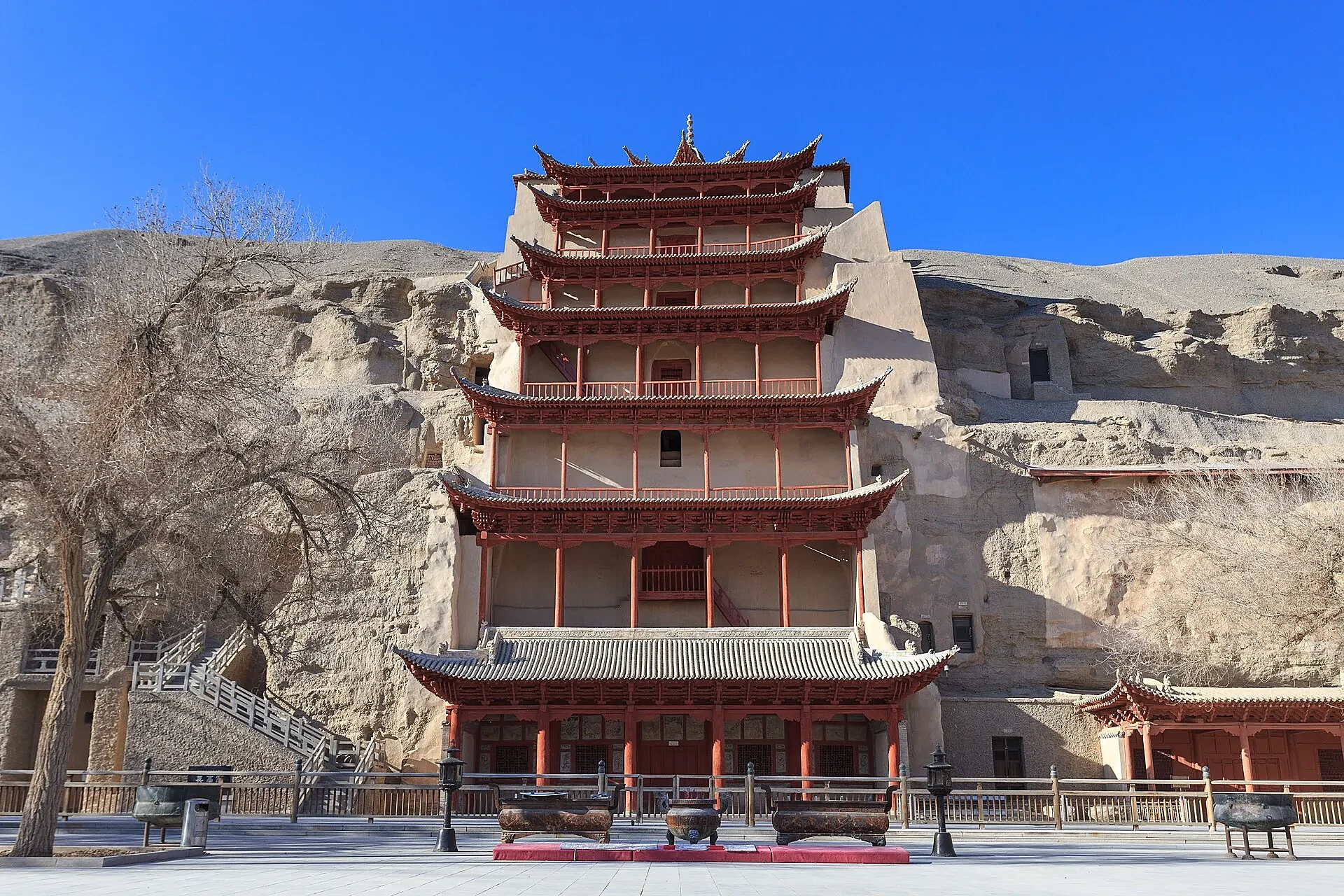
"MING UY" (xitoycha "Chyanfodung"), Mogaoku — Xitoyning Sinszyan-uygʻur muxtor rayonidagi togʻli hududlarda joylashgan budda gʻor ibodatxonalari. Ular Qizil (Kuchar viloyati), Turfon, Xesi yoʻlagi, Dunxuanda uchraydi. Dunxuandagi "Ming uy" ularning eng yirigi boʻlib uning rasmiy nomi — "Mogaoku" ("Qumlikdagi baland budda ibodatxonasi"). Ibodatxona hujrachalari qoyaning ichini oʻyib ishlash usuli bilan yasalgan.
Мога́о (кит. 莫高窟, пиньинь Mò gāo kū, «Пещера не для высоких») — крупнейшая пещера раннебуддийского пещерного храмового комплекса Цяньфодун («Пещера тысячи Будд»), воздвигнутого в 353—366 гг. н. э.
The Mogao Caves, also known as the Thousand Buddha Grottoes or Caves of the Thousand Buddhas, form a system of 500 temples 25 km (16 mi) southeast of the center of Dunhuang, an oasis located at a religious and cultural crossroads on the Silk Road, in Gansu province, China. The caves may also be known as the Dunhuang Caves; however, this term is also used as a collective term to include other Buddhist cave sites in and around the Dunhuang area, such as the Western Thousand Buddha Caves, Eastern Thousand Buddha Caves, Yulin Caves, and Five Temple Caves. The caves contain some of the finest examples of Buddhist art spanning a period of 1,000 years. The first caves were dug out in 366 CE as places of Buddhist meditation and worship; later the caves became a place of pilgrimage, and caves continued to be built at the site until the 14th century.
Die Mogao-Grotten (chinesisch 莫高窟, Pinyin Mògāo Kū) sind ein System mehrerer hundert Höhlentempel, gelegen in einer Flussoase an der Seidenstraße in der Großgemeinde Mogao (莫高镇) der Stadt Dunhuang, ca. 25 km vom Stadtzentrum entfernt. Dunhuang gehört zu Jiuquan in der chinesischen Provinz Gansu.
Hier haben buddhistische Mönche zwischen dem 4.
Les grottes de Mogao (chinois : 莫高窟 ; pinyin : mògāo kū ; litt. « grottes d'une hauteur inégalée »), ouvertes au public depuis 1980 (seules quarante grottes restent ouvertes au public, par roulement, dont dix en permanence), forment un ensemble de 492 chapelles bouddhistes ornées de peintures et sculptures. Elles font partie de l'ensemble plus vaste des grottes de Dunhuang, dans la province de Gansu en Chine, en marge du désert de Gobi. Ces chapelles ont été élaborées dans 735 grottes, dont 492 avec un décor peint et/ou sculpté, et creusées dans la roche par des moines à partir du IVe siècle.
Las cuevas de Mogao (chino: 莫高窟, Wade-Giles: Mo4kao1 K'u1, pinyin: Mògāo Kū) son un conjunto de 492 templos situados cerca de la ciudad de Dunhuang, en la provincia de Gansu de la República Popular China. Se las conoce también como las cuevas de los mil Budas (chino: 千佛洞, pinyin: qiān fó dòng), las grutas de Mogao o las cuevas de Dunhuang. En el año 1987 fueron declaradas por la Unesco como Patrimonio de la Humanidad.
Las cuevas de Mogao son el mayor ming-oi de Asia central, formando un conjunto de más de 400 templos, decorados con pinturas murales y donde encuentran miles de esculturas, manuscritos, etc.
Mogao mağaraları, (Çince: 莫高窟; pinyin: mò gāo kū), Mogao yeraltı odaları, Bin Buda mağaraları (Çince: 千佛洞; pinyin: qiān fó dòng) ve Dunhuang mağaraları adlarıyla da bilinir. Çin'in Gansu eyaletinin Dunhuang şehrinin 25 km güneydoğusunda Mingsha dağı eteklerinde bulunan mağaralarda 492 adet tapınak vardır. Tarihi İpek Yolu'nun üzerinde önemli bir vahada yer alan mağaralarda bin yıllık bir dilimi kapsayan süreç içinde yapılmış Budist sanatın en seçkin örnekleri bulunmaktadır. Budist yeraltı mabedlerinin yapımına 366 yılında başlanmış ve uzun süre çeşitli heykel ve sanat eserlerini saklamak amacıyla kullanılmışlardır.
莫高窟,俗称千佛洞,位于中国甘肃省敦煌市东南25公里处莫高镇的鸣沙山东麓断崖上,前临宕泉河,面向东,南北长1680米,高50米。洞窟分布高低错落、鳞次栉比,上下最多有五层,以精美的壁画和塑像闻名于世。它始建于十六国的前秦时期,历经十六国、北朝、隋、唐、五代、西夏、元等历代的兴建。现有洞窟735个、壁画4.5万平方米、泥质彩塑2415尊,是世界上现存规模最大、内容最丰富的佛教艺术地。
Manba: Vikipediya – “Ming uy” · CC BY-SA 4.0
Boshqa tillarda o‘qish: · · · · · · ·