
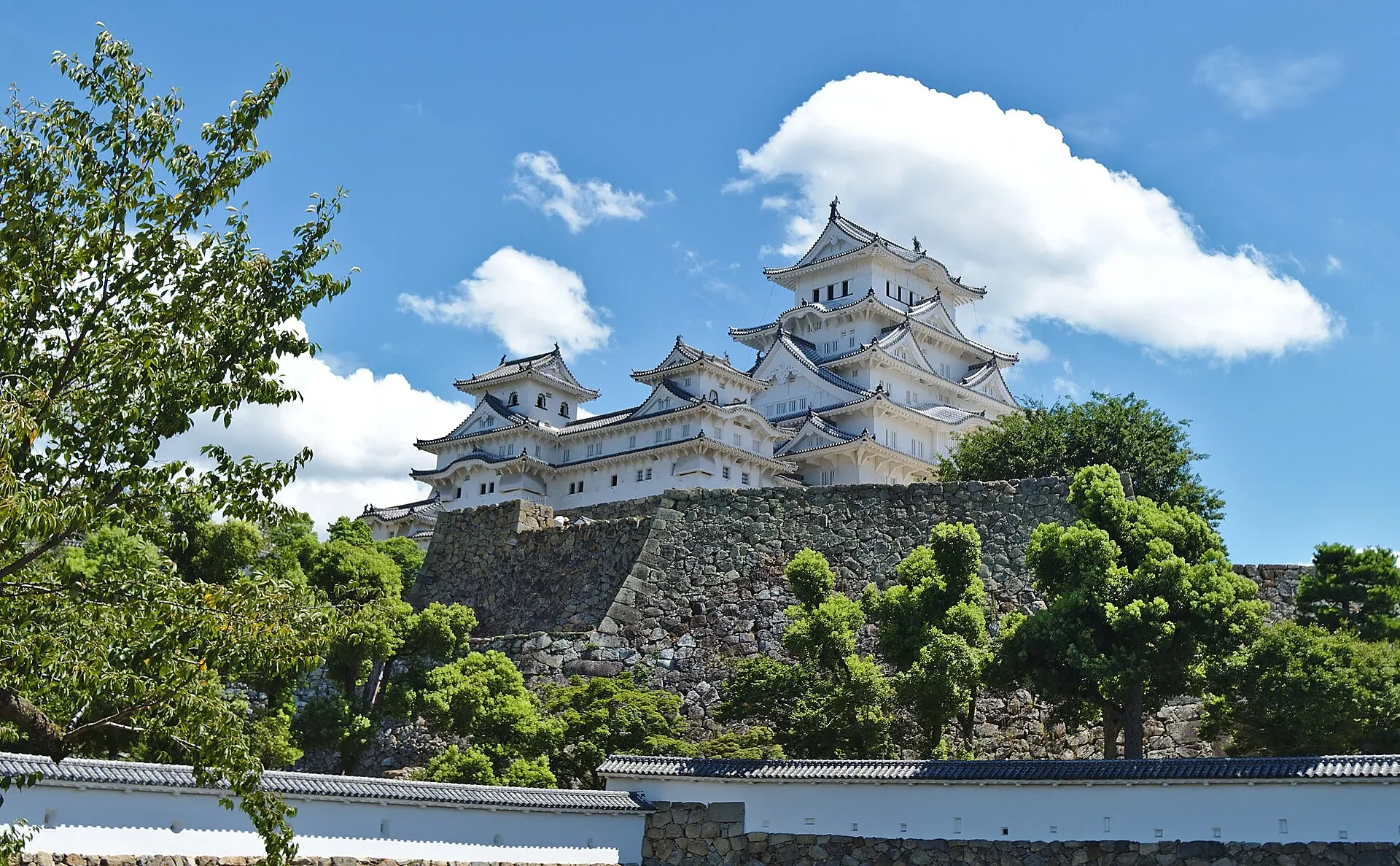
Himeji qalʼasi (yaponcha: 姫路城, Himeji-jō)、[çimeʑiꜜʑoː] ( tinglang) – Yaponiyaning Hyogo prefekturasidagi Himeji shahrida joylashgan, tepalik ustiga qurilgan qal’adir. Himeji qal’asi yapon ananaviy harbiy memorchiligining eng yaxshi saqlanib qolgan naʼmunasi hisoblanadi. Unda yapon feodal davrining eng ilgʻor mudofaa tizimlari bilan jixozlangan 83 ta boʻlma mavjud. Qal’a oʻzining yorqin oq rangda ishlangan tashqi fasadi va uchayotgan qushga oʻxshash koʻrinishdaligi tufayli mahalliy aholi orasida „Hakuro-jō“ yoki „Shirasagi-jō“ (Oq egret/qarqara qal’asi)) nomi bilan tanilgan.
Замок Химэдзи (яп. 姫路城 Химэдзидзё:), также «Замок Белой Цапли» — один из древнейших сохранившихся японских замков и самый популярный среди туристов. Был основан Акамацу Саданори и Икэдой Тэрумаса. В 1993 году занесён в Список всемирного наследия ЮНЕСКО. Всего в замковый комплекс входит 83 здания, практически все они построены из дерева.
Himeji Castle (姫路城, Himeji-jō; [çime̞(d)ʑiꜜ(d)ʑo̞ː] ) is a hilltop Japanese castle complex situated in Himeji, a city in Hyōgo Prefecture, Japan. The castle is regarded as the finest surviving example of prototypical Japanese castle architecture, comprising a network of 83 structures with advanced defensive systems from the feudal period. The castle is frequently known as Hakuro-jō or Shirasagi-jō ("White Egret Castle" or "White Heron Castle") because of its brilliant white exterior and supposed resemblance to a bird taking flight.
As with almost all Japanese castles from the Azuchi-Momoyama period onward, the tenshu (天守, main keep), the most prominent structure, was used as a storehouse in times of peace and as a fortified tower in times of war, and the daimyo (大名, feudal lord)'s government offices and residences were located in a group of single-story buildings near the tenshu and the surrounding yagura (櫓, turrets).
Die Burg Himeji (japanisch 姫路城, Himeji-jō) befindet sich in der Stadt Himeji in der japanischen Präfektur Hyōgo.
Sie ist eines der ältesten erhaltenen Bauwerke aus dem Japan des 17. Jahrhunderts. Die Burganlage, die aus 83 einzelnen Gebäuden besteht, gilt als schönstes Beispiel des japanischen Burgenbaus und hat den Beinamen Shirasagijō (白鷺城, dt.
Le château de Himeji (姫路城, Himeji-jō) est un château japonais situé à Himeji dans la préfecture de Hyōgo.
C'est l'un des plus anciens bâtiments du Japon médiéval. Désigné comme trésor national du Japon et inscrit au patrimoine mondial de l'UNESCO, c'est l'un des douze derniers châteaux japonais dont le tenshu (donjon) en bois est encore authentique (les autres châteaux ont été reconstruits après l'époque féodale, souvent dans les années 1960-1970). Il est aussi connu sous les surnoms de « Hakuro-jō » ou « Shirasagi-jō » (白鷺城, château du Héron blanc ou de l'aigrette blanche) en raison de sa couleur blanche et par opposition aux deux autres célèbres châteaux d'Okayama (donjon reconstruit) et de Matsumoto (donjon authentique), tous deux de couleur noire.
El castillo de Himeji (姫路城, Himeji-jō?) es un castillo japonés localizado en la ciudad costera de Himeji en la prefectura de Hyōgo (antiguo distrito de Shikito en la provincia de Harima), a unos 47 km al oeste de Kōbe. Es una de las estructuras más antiguas del Japón medieval que aún sobrevive en buenas condiciones; fue designado como Patrimonio de la Humanidad por la Unesco en 1993, también es un sitio histórico especial de Japón y un Tesoro Nacional. Junto con el castillo de Matsumoto y el castillo de Kumamoto, es uno de los "Tres Famosos Castillos" de Japón, y es el más visitado del país. Se le conoce a veces con el nombre de Hakuro-jō o Shirasagi-jō ("La garza blanca") debido al color blanco brillante de su exterior.
Himeji Kalesi (姫路城, Himeji-jō), Himeji, Hyōgo, Japonya'daki bir tepenin üzerinde bulunan bir Japon kalesi kompleksi. 1993'te UNESCO tarafından Dünya Mirası olarak tescillendi.
姬路城(日語:姫路城/ひめじじょう,羅馬化:Himeji-jō)是一座位於日本兵庫縣姬路市的城堡,為該市主體象徵。由於其白色的外牆,也被稱為白鷺城(白鷺城/はくろじょう・しらさぎじょう)。
作為日本最具象徵意義,且保留度最為完整的城堡,姬路城是日本政府指定的國寶及國家特別史跡,也是日本首批世界文化遗产之一。為日本100名城之一。
Manba: Vikipediya – “Himeji qalʼasi” · CC BY-SA 4.0
Boshqa tillarda o‘qish: · · · · · · ·