Bu matn hozircha boshqa tilda mavjud.
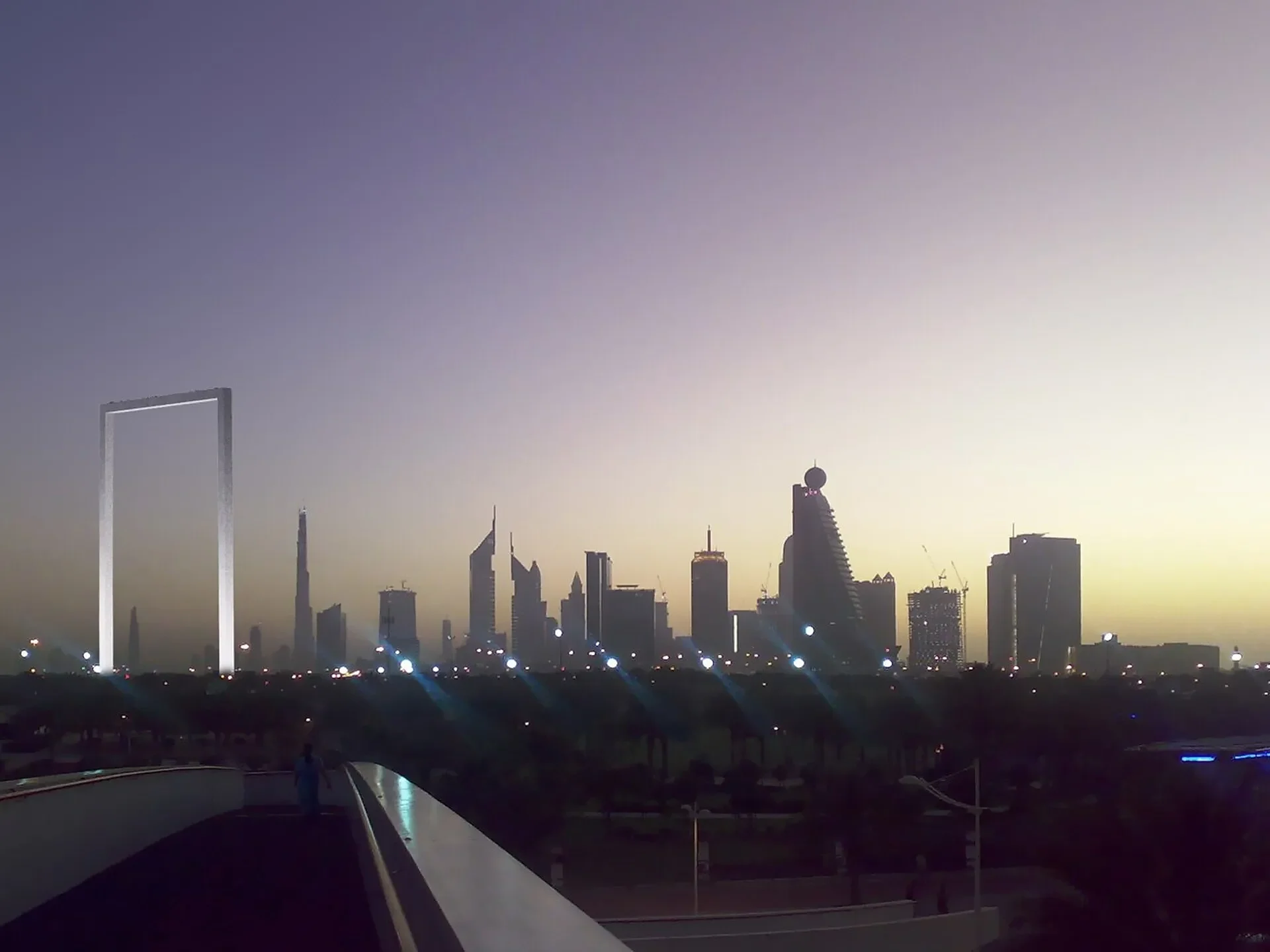
The Dubai Frame (Arabic: برواز دبي) is an observatory, museum and monument in Zabeel Park, Dubai. It holds the record for the largest frame in the world. The building has a height of 150.24 meters and a width of 95.53 meters. The building mainly serves as an observatory, providing views of old Dubai in the north and newer parts in the south.
The project idea was initially conceived by Fernando Donis through an architecture competition by ThyssenKrupp and Dubai Municipality, and selected as the winner of a design competition by an international jury. Donis has alleged that he had his intellectual property stolen and was denied credit for the design. The final project was completed by Hyder Consulting, part of Arcadis NV. It opened in January 2018. The Dubai Frame can take only 200 visitors per hour. Only groups of 20 will be sent to each of the augmented-reality stops – the Mezzanine level, the Sky Deck level and the Vortex Level.
Дубайская рамка (араб. برواز دبي) — архитектурная достопримечательность в парке Забиль в Дубае, открытая для посещения 1 января 2018 года. Объект является рекордсменом по величине кадра в мире. Несмотря на то, что газета The Guardian назвала её «самой большой картинной рамкой на планете», она вызывает споры, так как архитектор описывает её как «самое большое украденное здание всех времен».
Проект был задуман Фернандо Донисом и выбран в качестве победителя конкурса дизайна правительством Дубая. Дизайнер утверждал, что у него украли его интеллектуальную собственность, и ему было отказано в оплате за дизайн.
Der Dubai Frame (deutsch: „Rahmen von Dubai“) ist ein am 24. Januar 2018 eröffnetes Hochhaus in der Stadt Dubai in den Vereinigten Arabischen Emiraten.
Le Dubaï Frame (arabe: الإطار دبي) est un projet architectural imaginé et conçu par Fernando Donis. Le design, qui s'apparente à un cadre photo, a été choisi, comme le lauréat du prix international 2009 ThyssenKrupp Elevator, parmi 926 propositions. Les participants du monde entier ont été invités à soumettre un emblème qui favoriserait «le nouveau visage de Dubaï». C'est un projet en cours de réalisation à Dubaï, près de la Porte Étoile du Parc Zabeel pour une hauteur de 150 mètres. Il est positionné de telle sorte que les repères représentatifs du Dubaï moderne peuvent être vus d'un côté, tandis que de l'autre côté, les visiteurs peuvent admirer le patrimoine plus historique de la ville.[réf. nécessaire]
Le site sera desservi par la station de métro Al Jafiliya, via la Ligne Rouge, ainsi qu'une station de TaxiDrone. Debut 2017, l'architecte et la municipalité de Dubaï sont engagés dans un litige juridique sur la propriété des droits du bâtiment.
El Dubai Frame (en árabe: برواز دبي , traducible al español como Marco de Dubai) es un edificio ubicado en la zona céntrica de Dubái, en los Emiratos Árabes. El periódico británico The Guardian lo ha descrito como "el marco de fotos más grande del planeta", sin embargo, también es controvertido como el "edificio robado más grande de todos los tiempos".
Conocido antiguamente como Torre de Al Berwaz, el proyecto fue concebido por el arquitecto mexicano Fernando Donis, y seleccionado como ganador de un concurso de diseño por parte del Gobierno de Dubái. Se alega que al diseñador le robaron su propiedad intelectual y se le negó el crédito por el diseño. Según Donis, cuando diseñó la estructura, vio a Dubái como una ciudad llena de emblemas y, en lugar de agregar otra, propuso enmarcar la ciudad. En lugar de construir una estructura masiva, el propósito de la propuesta era construir un vacío de 150 por 105 metros para enmarcar continuamente el desarrollo del pasado, el presente y el futuro de Dubái, convirtiéndose en la estructura que celebra y al mismo tiempo limita la ciudad.
Manba: Vikipediya – “Dubai Frame” · CC BY-SA 4.0
Boshqa tillarda o‘qish: · · · ·